


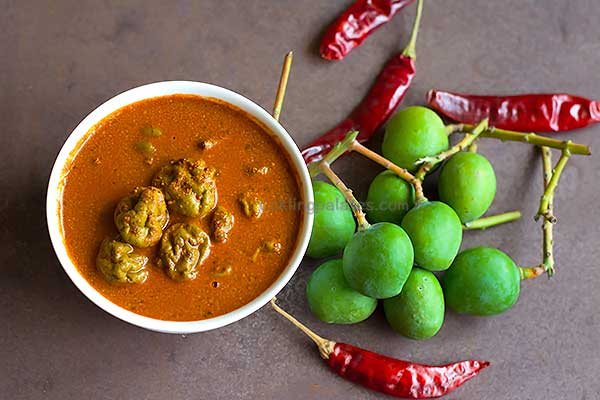
Maavadu or vadu mango pickle recipe. An easy pickle recipe using baby mangoes (vadu mangai) that requires no cooking, no cutting, minimal oil that can be stored for more than a year.
A specific variety of mango is used to make “vadu mango” pickle. We had an orchard full of this special variety mango for maavadu and avakkai and Narthangai (citron) which were leased out leaving out 2 or 3 trees which were for our personal use.
During the season, the lessee will bring in his own men to harvest the mango and citrons and apart from paying the lease amount, he will also instruct his men to harvest the fruits from the trees left out for own own use.
During those days, the entire neighbourhood will look festive and we will literally be surrounded by the aroma of the freshly plucked mangoes and citrons.
The next few days following the harvest, are the busiest.
We will have maids performing various tasks like cleaning the bharanis and glass horlicks bottles.
Our Favorite Video:
Followed closely by lining the wooden boxes in the store room with fresh hay, hand pounding dry red chilies into powder, the guy who will regularly climb the coconut tree to pull out the coconuts will be brought in to cut the mangoes and citrons into chunks.
Nowadays we buy things in kg measurements but back then it was measured in “padi kanakku”.
The maids who come into pound the chili will be compensated by “padis” of “nel” (grains) and will also be given a “padi” of “nallennai” (sesame oil) to clean themselves from the pungency of the chili, so that they won’t be affected by its heat.
How to pick Vadu Mango:
Choose smaller mangoes that are round in shape. It should be green and not tinted with yellow shades. Even if it is slightly tinted with yellow, do not buy it as it has started to age and then if you use it, the pickle will spoil quickly.
Press gently. It should be very hard like a pebble. Choose them as they are the freshest.
Pick the ones with the stems attached. It means that they are shaken or plucked right off the tree and not picked up from the ground that had fallen off the tree & could have been lying around there for some time.
Make sure to remove the stem from the vadu mango before billing. You don’t want to be billed for the stem weight too, right:).
Make sure that the surface is smooth and the mangoes do not have any cuts or bruises on the surface.
Preservative:
Castor oil is used as a preservative which is used to coat the mangoes. The viscosity of castor oil is high and it prevents air and moisture from making contact with the maavadu.
Because the oil is very sticky, it helps the salt to stick to the mangoes well which in turn draws out the moisture and water from the mango quickly to form the brine.
Also baby mangoes secrete a sort of milk at the stem while plucking. It is acidic in nature and is known to burn the corners of one’s mouth when eaten raw. It is also considered to increase your body heat. To balance it out, castor oil is added which is a natural body cooler and also makes the acidity to go away.
Because of this, some don’t bother to remove the stem and include it for pickling too. I personally discard the stem because it would take up more space & demand a larger container and anyways at the end, you will be consuming only the pickled mango and not the stem.
In short, castor oil is added for a reason. It is not only just added as a preservative alone but also to regulate the acidity of the baby mango. If you do not have it on hand, you can always use sesame oil. Do not use any other oil apart from both these.
Vessels to use:
It is preferable to use ceramic jars (Peengan jaadis or Bharanis) and Glass bottles .
You can also use food grade plastic bottles or boxes or buckets if doing in large scale.
I prefer to use a long rectangle or cylindrical plastic box so that it is easy to shake it daily. This way I don’t have to use a spoon to stir it and also don’t have to worry about how clean and dry the spoon is.
Once the maavadu starts oozing water and the pickle is ready which normally takes about 2 weeks, I transfer to several 500 gms glass bottles for ease of use.
I’m the only person who eats maavadu at home, the others at home are crazy about only the brine or maavadu water. They usually eat only avakkai and lemon pickle.
So I usually buy 2 kgs of maavadu for pickling as it anyway gets reduced or shrunk to 1 kg or probably much less once it gets ready. That is enough just for me for a year and the guests who visit occasionally.
Maavadu Recipe details below:
Maavadu Recipe - Vadu Mango Pickle
Ingredients
- Maavadu or baby mangoes - 2 kgs
- Red chili powder - 1/4 cup
- Mustard seeds - 1/4 cup
- Rock salt - 1/3 cup
- Turmeric powder - 1 tbsp
- Castor oil or Sesame oil - 3 tsp
Instructions
Preparation:
- Remove the stem from the maavadu and immerse it in a bucket of water. Wash well, drain the water and repeat it again.
- Spread the washed maavadu over a dry cloth and let it air dry completely. There should not be any moisture at all.
- Meanwhile wash the vessel in which you are going to make the pickle and let it also air dry completely. You can also keep it in direct sunlight for 1 hour to dry it. You can also coat the insides of the jar with castor oil as an extra precautionary measure.
To make Maavadu:
- Place all the maavadu in the jar.
- Drizzle castor oil on top. Close with lid and shake well for the maavadus to get coated well with oil.
- In a mixie jar, add rock salt and powder it.
- Open lid and add the powdered salt. Once again close with lid and shake well. The salt will stick well to the oil coated maavadu.
- Take mustard seeds in the same mixie jar and grind to a fine powder. Add red chili powder, turmeric powder and pulse few times to mix well.
- Open the lid and add the powered spices. Close with lid and once again shake the vessel several times for even distribution.
- Close with lid and keep aside.
- From the second day on shake or stir the mangoes twice a day daily, preferably during morning and evening.
- If you see the spice powder settled at the bottom, not to worry as it will get dissolved once the brine begins to release.
- From the third day on, the mangoes will start to release out the water.
- After a week or so, the mangoes will look shrivelled and half the vessel will be filled with the brine.
- Continue the shaking process for another week.
- By the 2nd week, the 2 kgs mangoes would have shrunk well and will become 1 kg and would have settled at the bottom of the vessel and the brine or the maavadu water will float on top.
- Maavadu is ready for use. You can either store it in the same vessel or divide it between smaller jars to facilitate daily use or to distribute to friends and family.
- When done and stored properly, maavadu will stay well for over a year at room temperature.


Ankur, IncomeBoy
Hi Radhika, I am very fond of mangoes before reading this post I had no idea about Vadu mango pickle however after going through this post i asked my mom to make this for me as you have explained the recipe in a very simple manner. Kindly share some more delicious recipes.
Thank you
Hi Ankur, Thank you very much. I’m sure you will like it as much as I do.
Donna
What a brilliant post and I definitely learnt so much with the information you provided. Thanks
Hi Donna! Thank you so much. Glad you liked it.
Subadra
Hello! We love vadu mangai pickle and we are growing our own mangos. However, I am trying to find the specific variety of mango that is used in this pickle. For example it isn’t baby alphonsos, right? So, would you know the name of the variety? We aren’t in India so we can’t just buy the raw ones from the market. Thanks so much.
Prithvi
Hi Radhika…I am planning to make this pickle. Can you tell me your 1 cup measurement?